

Tapir points reward two types of eligible activity on the Zircuit_zvUSDC 261214 market: holding Depeg Protected (DP) or Yield Boosted (YB) positions, and providing liquidity in the DP/YB automated market maker (AMM).
The important distinction is between raw points and finalized points. Raw points are calculated from eligible activity. They can still be reduced by pool-level caps, proportional scaling, validation, exclusions, or a successful challenge. Once that process is complete, the ledger records the finalized amount.
Under the current program rules:
Every finalized Tapir point converts into one TPR token (1:1).
That conversion rule does not give raw or provisional points a cash value, and it does not set a TPR launch date, market price, liquidity level, or regulatory treatment.
The pool is live on Base and open for partner participation. The coordinated public limited-access launch took place on September 22. Joining the pool before point activation does not itself earn points for those earlier days.
The live pool
Zircuit_zvUSDC 261214 is on Base. It was deployed on 1 September 2026 at 09:19:33 UTC with a 104-day onchain term and matures on 14 December 2026 at 09:19:33 UTC, giving approximately 83 days remaining at the September 22 public launch. AMM swaps are planned to pause on 11 December, three days before maturity. Later entry shortens the remaining term; the public announcement does not move maturity.
The underlying Zircuit Finance vault share continues to accrue variable yield. That yield is separate from Tapir points and can change over time.
Point eligibility starts on 25 September 2026 at 00:00 UTC, as set out in the published activation notice:
Eligible AMM fee growth begins counting from that timestamp.
Holding points require a complete UTC day, so the first eligible holding day is 25 September 2026. There are 80 complete eligible days through 13 December.
Two ways to generate raw points
1. Hold DP or YB
The September 10 policy approval sets the opening holding multiplier at α = 0.02 raw points per eligible dollar-day.
The calculation uses the minimum combined eligible DP and YB principal that a participant economically owns throughout a complete UTC day, including eligible principal in attributable liquidity positions without double-counting it. A balance held for only part of the day does not count as a complete day.
For this pool’s points accounting, one zUSDC is valued at $1. The value of a zvUSDC vault share is derived from how much zUSDC the vault reports it can redeem for at the approved sampling block. This accounting convention does not promise a $1 market or redemption price for zUSDC and does not change depeg settlement. The examples below use this points-accounting value.
For example, an eligible position with a constant value of $100,000 for seven complete UTC days generates:
0.02 × 100,000 × 7 = 14,000 raw points
This is before target scaling, validation, exclusions, challenge, and finalization.
2. Provide DP/YB AMM liquidity
The approved AMM multiplier is β = 116 raw points per eligible dollar of fee growth. It is retained under an approved exception with a 40% per-owner AMM target cap and an external-volume cap. Automatic β increases are disabled under that exception.
AMM points follow eligible fee growth. They are not calculated simply from the amount deposited or from headline trading volume.
The pool configuration uses a planning example with $100,000 of liquidity, 10% daily turnover, and a 0.1415% swap fee over seven days:
$100,000 × 10% × 7 × 0.1415% = $99.05 of fees
$99.05 × 116 ≈ 11,490 raw points
The AMM fee is dynamic, so this is a worked planning example rather than a forecast.
An eligible liquidity position can generate both holding and AMM points when it satisfies both sets of rules. The streams are calculated separately. This is not an automatic “2×” reward.
Targets cap the epoch total
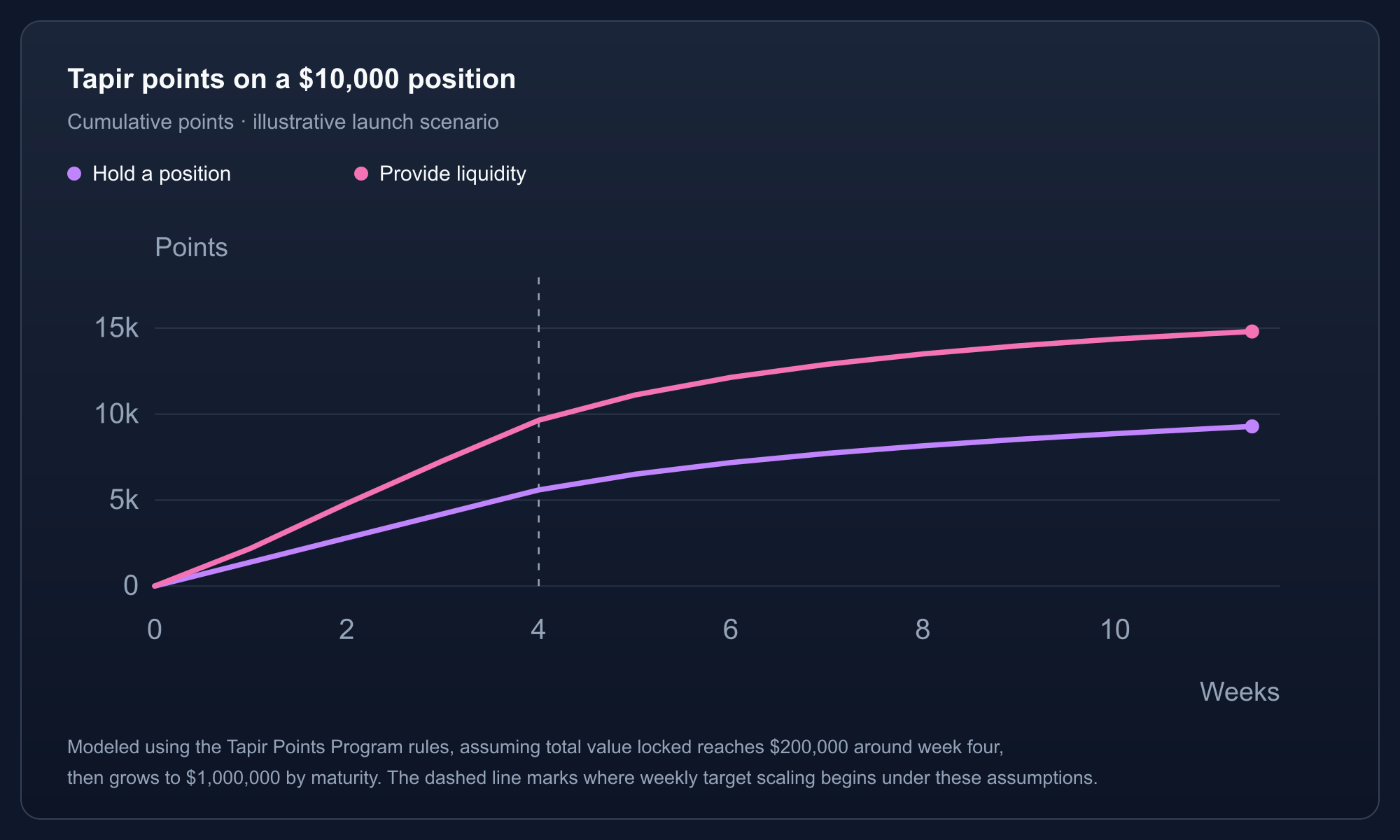
Each epoch has separate pool-level targets for holding points and AMM points. Each target caps its own channel; it is not a promised payout.
At or below target: raw points are not reduced by target-cap scaling. Eligibility, validation, exclusions, challenge, and finalization still apply.
Above target: raw points are reduced proportionally so the finalized epoch total does not exceed the target.
If an epoch produces 150% of its target in otherwise eligible points, proportional scaling reduces each participant’s amount to two-thirds. No participant jumps ahead of another through that step. On the AMM side the caps come first, so the scaling factor is computed from the amounts that survive the per-owner and external-volume caps, not from the raw total. Where a cap bites hard enough, the surviving total can fall below the target and no scaling is applied at all.
The first four launch epochs are excluded from feedback. The first eligible observation is Epoch 5 and the earliest resulting adjustment is Epoch 7, subject to finalization and the program’s limits and controls. Automatic β increases remain disabled under the approved exception. Adjustments cannot change points retrospectively.
The revised program starts at global Epoch 1 on September 25 at 00:00 UTC. These approved opening caps have passed the free-budget check and are registered against the program budget:
Epoch 1 (25 Sep–1 Oct): 7,000 holding / 2,000 AMM.
Epoch 2 (2–8 Oct): 14,000 holding / 3,600 AMM.
Epoch 3 (9–15 Oct): 21,000 holding / 4,900 AMM.
Epoch 4 (16–22 Oct): 28,000 holding / 5,800 AMM.
Across those four epochs, the approved combined cap is 86,300 points. The approved 12-epoch schedule totals 314,700 points (278,000 holding and 36,700 AMM), including a final three-day holding-only tail. The allocation ledger records the full 314,700-point schedule as committed, leaving 119,685,300 of the 120,000,000-point program budget free. The target schedule controls the maximum finalized total for the pool in those epochs. It is not a minimum distribution.

Finalization and unlock
Raw calculations remain provisional until all finalization requirements are met, including eligibility, integrity checks, exclusions, target scaling, budget checks and challenges. A finalized ledger is immutable. Closing a challenge window alone does not make points final.
Tapir plans to announce its token generation event (TGE) and its date when protocol total value locked (TVL) reaches $10 million. The proposed schedule and any announced date may change. This is a protocol-wide milestone, not the target for this individual pool, and reaching it does not trigger an immediate TGE.
The applicable vesting and unlock terms for this pool have not yet been announced. The fixed 1:1 conversion does not mean tokens are immediately claimable.
The current specification allows earning ledgers to finalize before TGE and unlock dates are announced. Withdrawals require both finalization and unlock. The proposed unlock follows the original daily earning sequence from a separately announced start, expected shortly after TGE/public sale; this article does not announce an unlock schedule or a claim date.
Risks still apply
Points do not remove the risks of the underlying position. Tapir is market-priced risk transfer, not insurance. The main risks are:
DP protection limits. DP receives priority under the settlement formula when the configured oracle records a depeg at resolution, but the formula has a structural cap. DP holders can still take a loss.
YB first-loss exposure. YB takes first-loss exposure under that formula and can lose its full tranche value in a sufficiently severe recorded depeg.
Liquidity provider exposure. LPs face price-range and inventory risk. Inventory can concentrate in the losing side, and trading income may not offset losses.
Underlying vault risk. Strategy losses, valuation errors, or withdrawal restrictions at Zircuit Finance can affect the zvUSDC backing the pool, as can its bridge, network, and USDC dependencies.
Oracle and operator risk. Settlement depends on the vault’s own redemption quote, USDC price feeds, and operator activity. Incorrect data, missing data, or admin actions can affect or delay resolution.
Exit and timing risk. Limited liquidity, pauses, and settlement waits can delay an exit or make it more expensive.
Smart contract risk. Tapir’s contracts, the vault, and their dependencies can fail.
Read more before participating:
Zircuit USDC pool page, Risks: pool-specific risks, oracle configuration, and contracts.
Zircuit Finance USDC Vault Risk Analysis: Tapir’s analysis of the underlying vault’s investments, withdrawals, valuation, and controls.
Security & Audits: Tapir’s risk overview, audit reports, and administrative powers.
Zircuit Finance security: Zircuit’s published audit reports for its vaults, bridges, and strategies.
Quantstamp reviewed the stated December 2025 code versions. Hashlock reviewed the later code path and final fixes through 29 July 2026. The deployment-specific independent review of the atomic settlement executor, required by the September 16 operational checklist, has been completed. Audit scope matters, and audits are not assurances of safety. Monitoring can pause AMM swaps on configured triggers, but it cannot prevent or reverse a loss.
Access and current terms
The market is live on Base and open for partner participation, following the public limited-access launch on September 22. Point earning starts on September 25 at 00:00 UTC under the published activation notice. Request access, or use your existing Tapir contact. Before participating, request the current pool configuration, points specification, eligibility terms, audit reports, and risk analysis. General protocol documentation is available at docs.tapir.money.
Important information. This article is a dated summary, not an offer, solicitation, recommendation, or financial, legal, tax, or investment advice. Tapir points are incentives, not vault yield or an annual percentage yield. Raw and provisional points are not entitlements. Multipliers, targets, eligibility, and schedules can change prospectively under the current program rules; finalized ledgers are immutable after the challenge process. The 1:1 conversion applies to finalized points and does not imply a cash value, TPR launch date, market price, liquidity, or future return. Participation remains subject to eligibility, anti-manipulation controls, and jurisdictional restrictions. Users can lose some or all of their capital. The figures above were checked against the September 18, 2026 configuration, whose policy was approved on September 17. Its fee and turnover examples are planning assumptions, not current quotes or forecasts.