


Points programs didn’t disappoint because incentives don’t work; they disappointed because their issuance was hard to model and their rewards were easy to game. Most incentive programs tend to break in predictable ways: they issue rewards without a hard budget, pay for metrics that are easy to game, or rely on volume signals that invite wash behavior. Tapir’s incentives design starts from the opposite premise: we expect & encourage users to game the system.
Every incentive program is a game for users to play. The issue is that most of them are just badly designed. They tended to reward metrics such as “usage” or “user growth” which, even if they could be measured in an anonymous system, didn’t seem to help the protocol in the long run.
In order to provide good UX (low spreads) we need deep enough liquidity and that is exactly what we incentivize. We have clear liquidity targets for each depeg pool and its associated market, and a control mechanism that dynamically adjusts rewards to achieve them.
Emissions are budgeted per pool, AMM rewards are linked to fees earned, and both streams are capped to prevent unwanted token dilution. This article explains the mechanism, why it was chosen, and how to participate without guessing.
Key Takeaways
Modelable emissions, treating points as underwritable token issuance: 120M TPR points budget, per-pool caps, and clear rules.
Incentives are organized by Depeg Pool: every pool has a corresponding DP/YB token pair plus an associated AMM that trades that pair. Both the pool and its AMM have concrete targets for each epoch.
Two types of incentives: TVL rewards are time-bound, and AMM rewards are utility-driven (fee-based).
Multipliers are the steering wheel to attract activity in a pool.
Targets are the emission budget (hard cap); scaling enforces the cap if demand is too high.
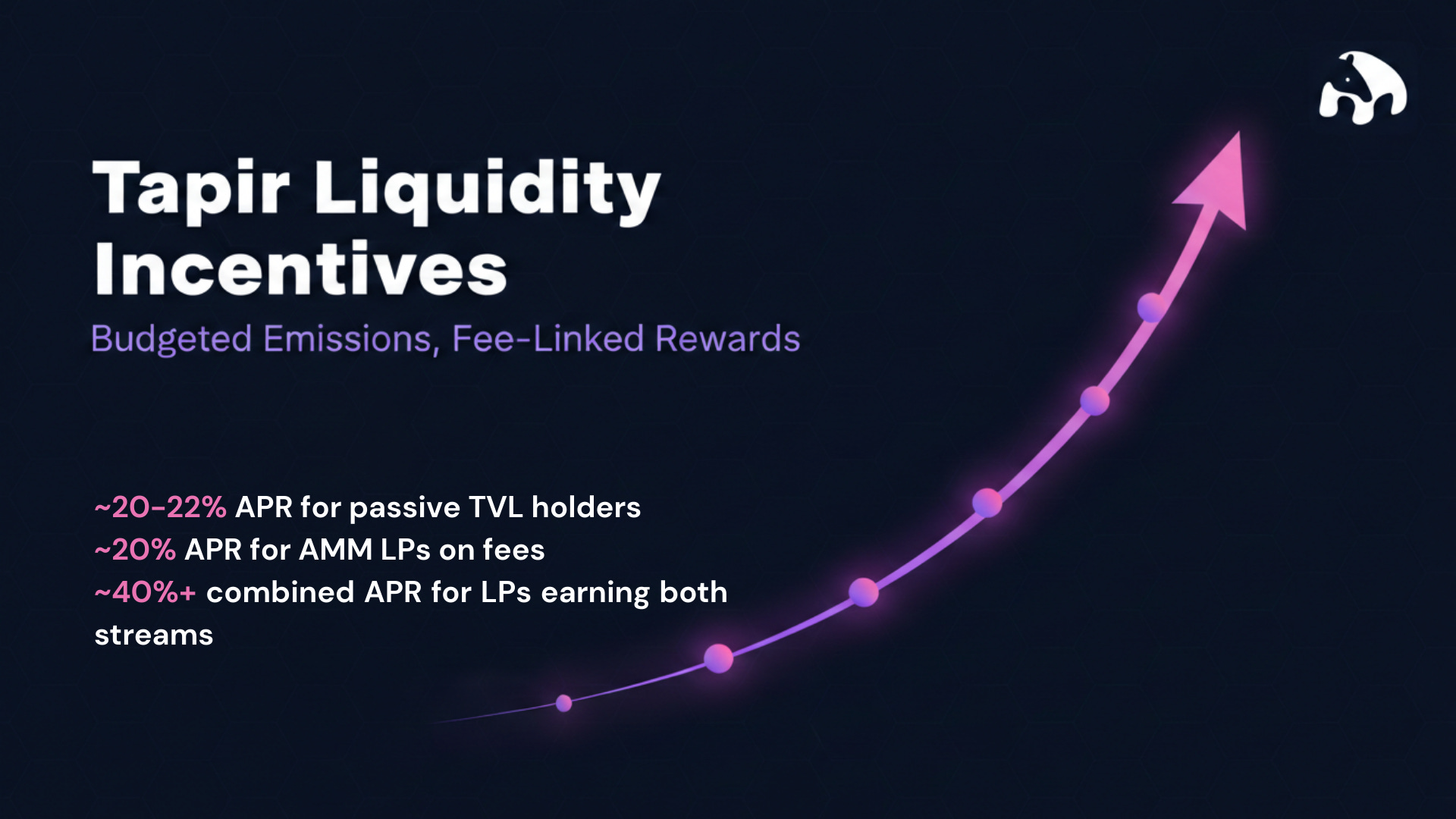
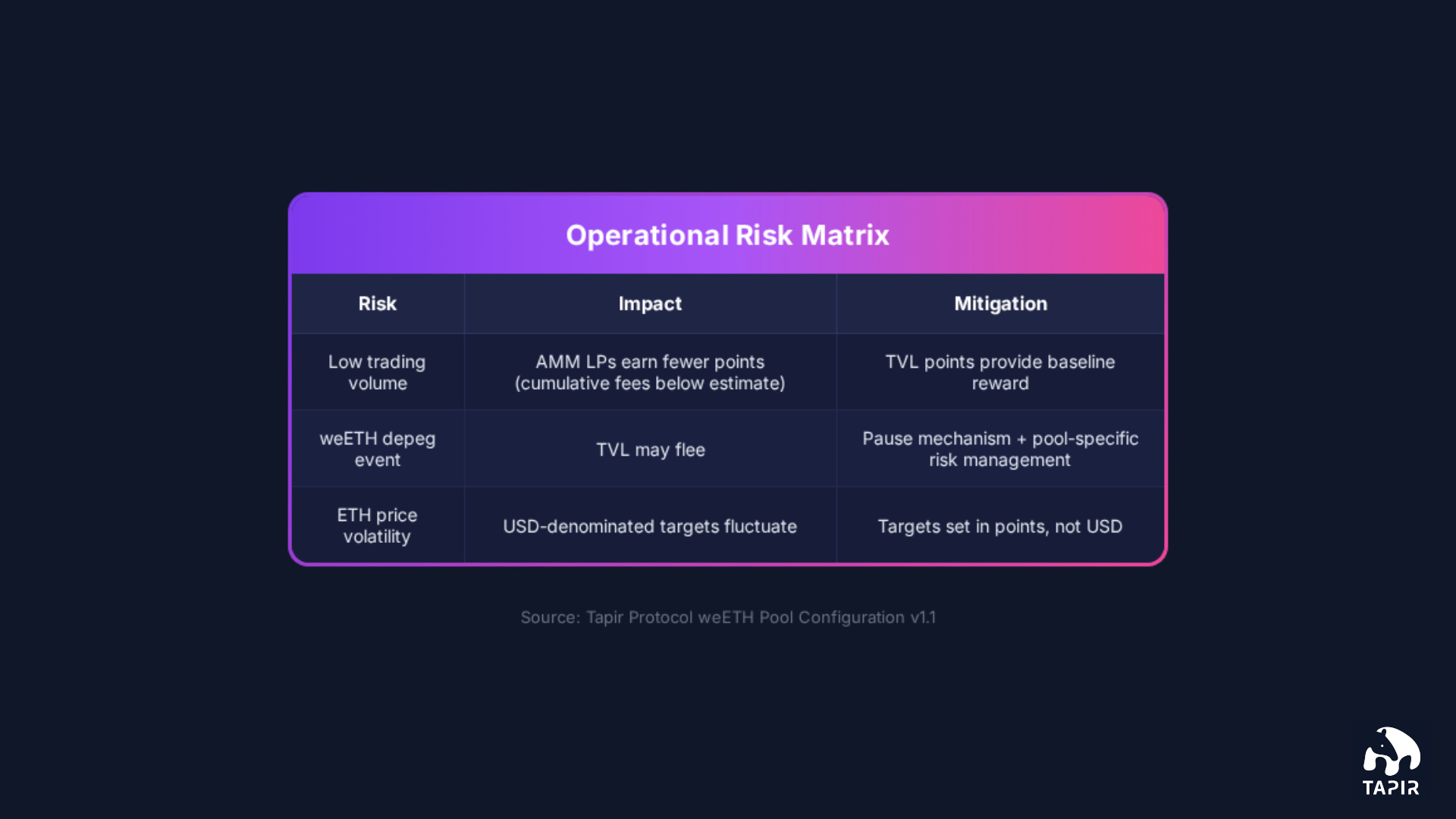
Target APRs: ~20–22% APR for passive TVL holders, ~20–22% APR for AMM LPs on fees, and ~40%+ combined APR for LPs earning both streams (before base yield and subject to pool utilization and scaling caps).
Points convert to TPR at a fixed 1:1 ratio and are time-locked before conversion; you can earn quickly, but you cannot exit instantly. Emissions you can underwrite
It’s broadly recognized in DeFi that most points and incentives programs often pay for TVL and activity without filtering for durability or conviction. Behaving as though emissions were a no-cost lottery, airdrops tend to reward mercenary behavior: “paper TVL” first, post-TGE sell pressure later.
Emissions you can Underwrite
It’s broadly recognized in DeFi that most points and incentives programs often pay for TVL and activity without filtering for durability or conviction. Behaving as though emissions were a no-cost lottery, airdrops tend to reward mercenary behavior: “paper TVL” first, post-TGE sell pressure later.
The track record of points programs is mixed at best: misalignment, dilution, wash trading, opacity, fragile liquidity. Still, they exist for a reason, and Tapir’s design is an attempt to keep the benefits while fixing the failure modes. Protocols need a way to bootstrap liquidity and reward early risk-taking. Tapir is trying to do that in a way that allocators can actually model.
Tapir’s liquidity incentives pay for two things that the protocol can actually measure and the market can actually price. The idea is to optimize for both sticky and useful liquidity. We also cap emissions by design so dilution stays bounded and forecastable.
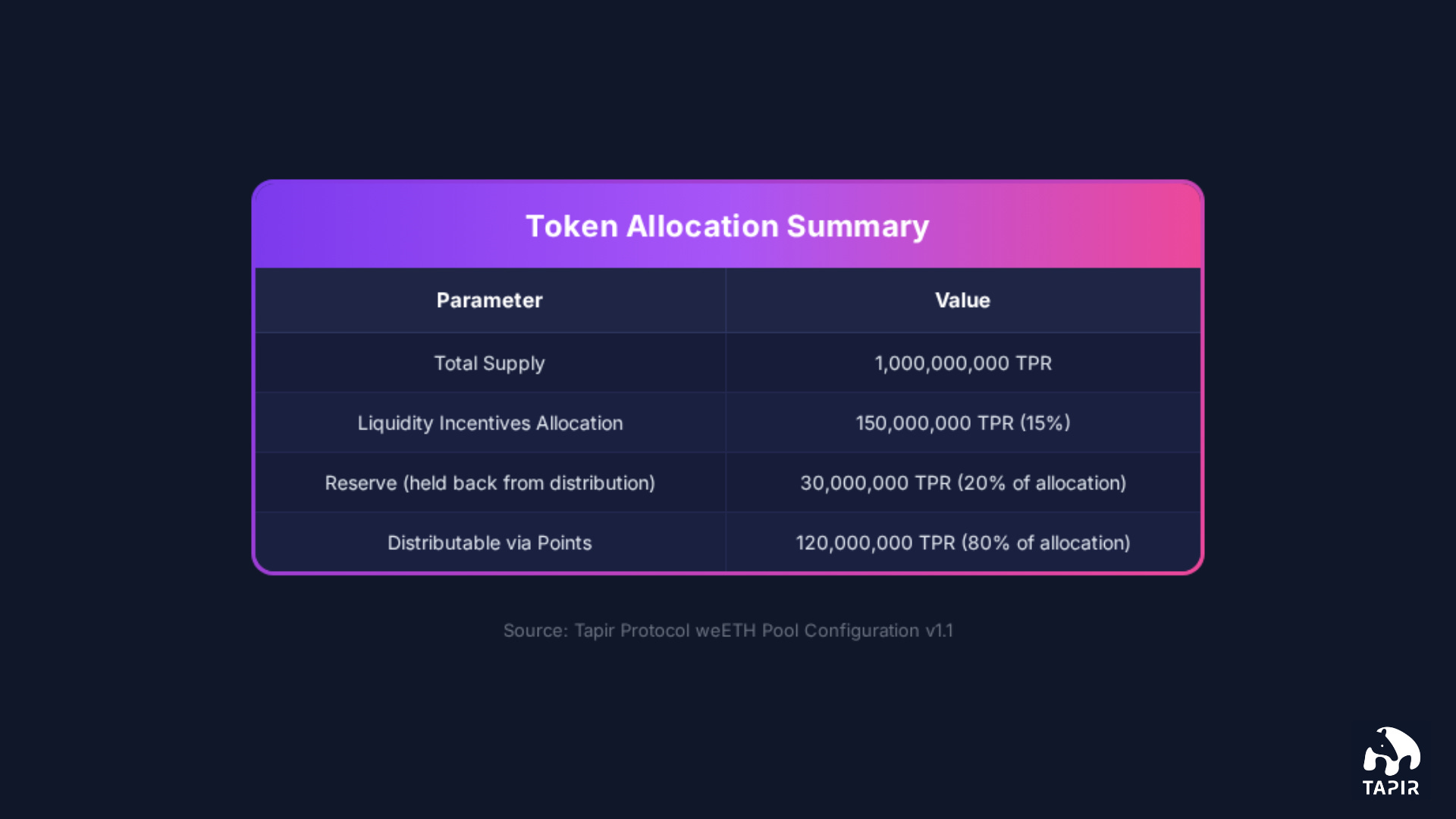
Tapir treats incentives as an underwriting problem: each pool has a weekly points budget, and if demand exceeds it, everyone takes the same proportional haircut. AMM rewards track fees earned rather than idle liquidity. Multipliers then reprice each pool weekly to keep participation near target. TVL incentives buy time-sticky participation (positions held through full UTC days) while AMM incentives buy useful liquidity (fees earned, i.e., trades actually settled).
We calibrate each pool to target the following incentive APRs (in TPR value):
~20–22% annualized on TVL holdings (DP/YB held through full UTC days).
~20–22% annualized on AMM liquidity (fees earned).
~40%+ combined for LPs earning both streams.
Maximum target range: up to ~100% APR in exceptional bootstrapping phases.
These targets are pool-specific, and are implemented through:
α (TVL multiplier) → controls points per dollar-day.
β (AMM multiplier) → controls points per dollar of fees earned.
Under the weETH launch configuration, for example:
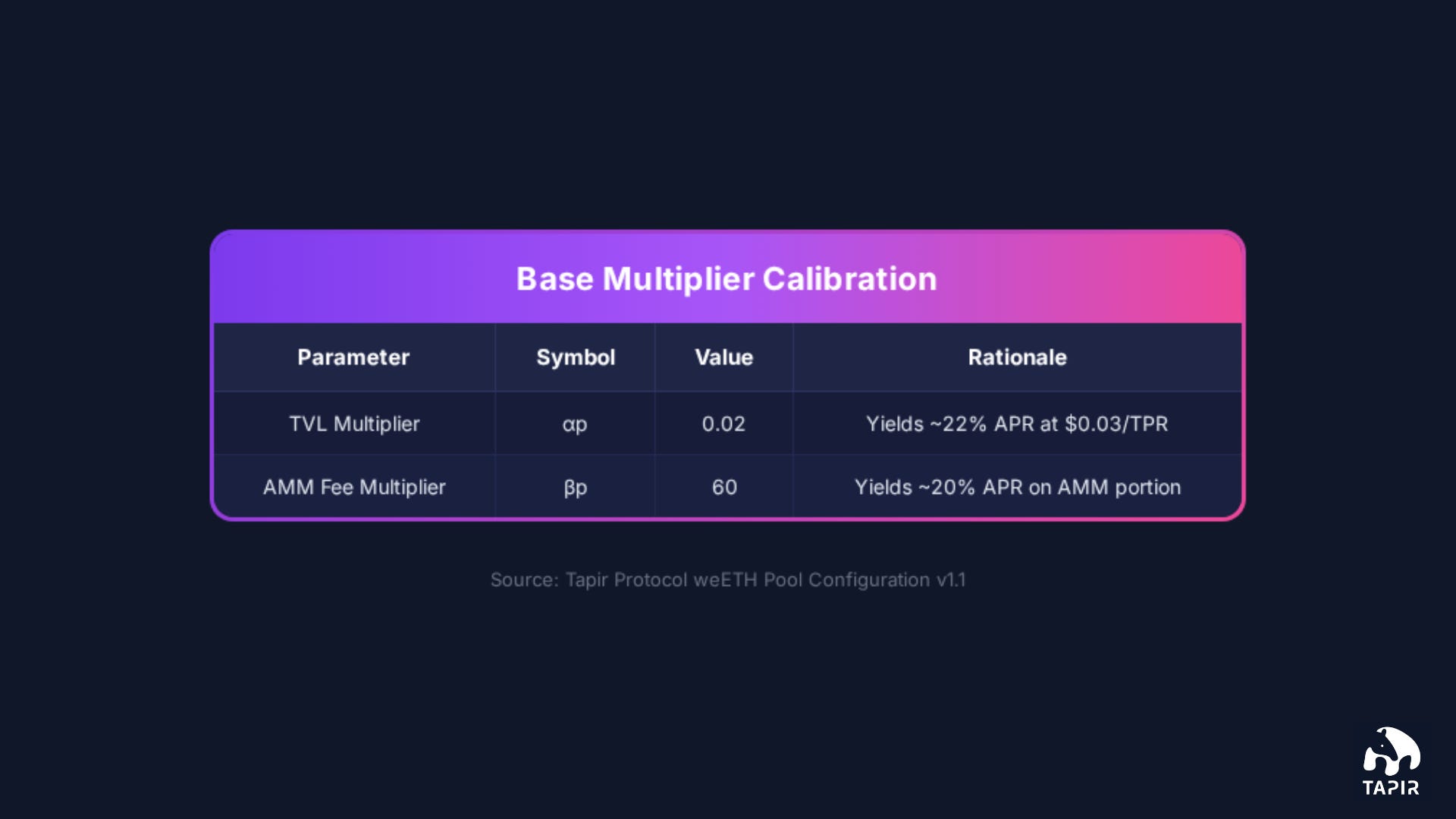
α = 0.02 → ~21.8% TVL incentive APR at $0.03/TPR.
β = 60 → ~19.7% AMM incentive APR under baseline turnover assumptions.
These APRs are targeted, not guaranteed. They are also subject to a pool’s demand based on the weekly emissions budget. Finally, these rewards are also independent of the underlying asset’s base yield (which remains fully productive).
Why TVL (Liquidity-based) Incentivization
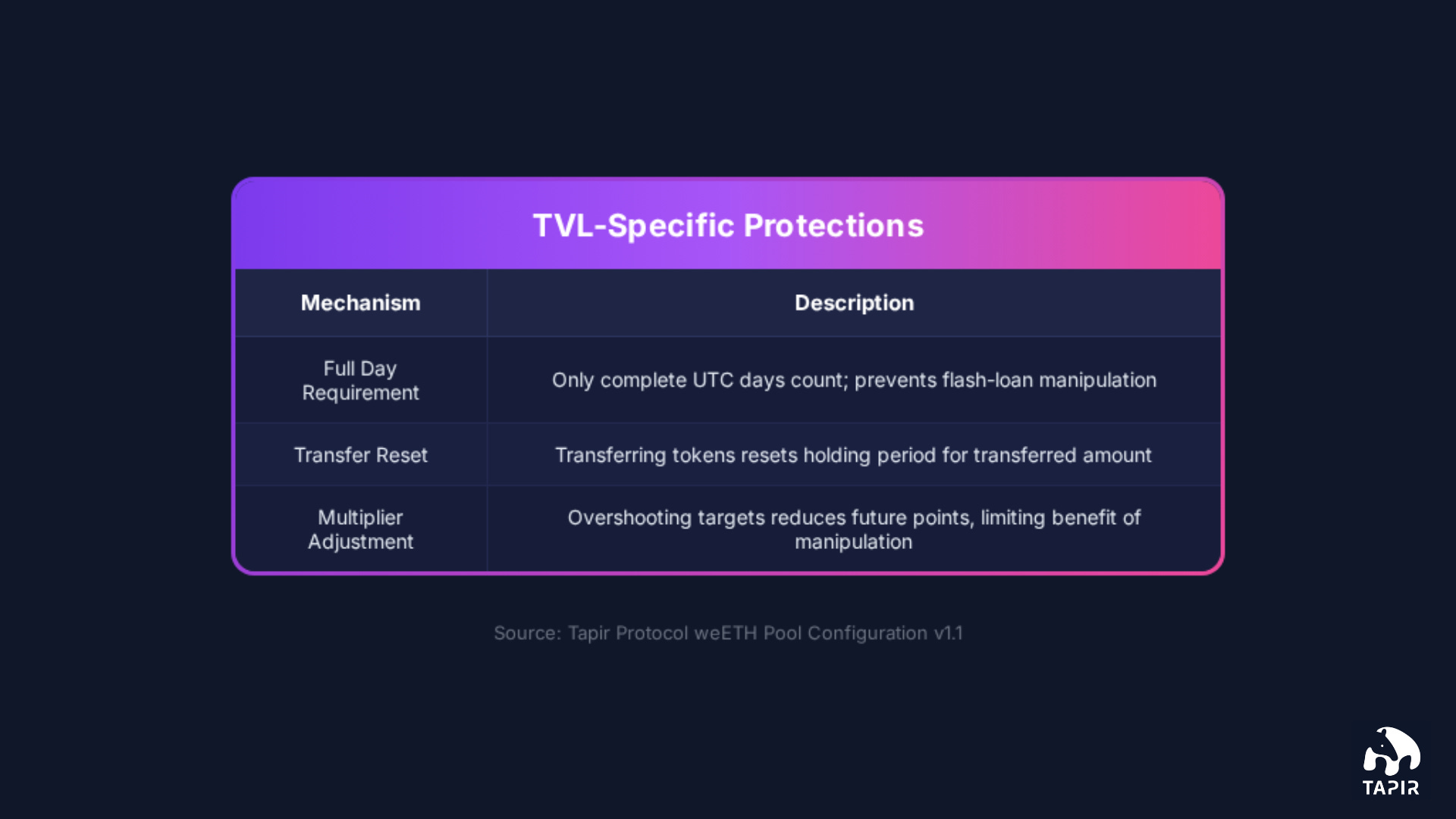
TVL incentives are the protocol’s budget to onboard the first cohort of users that will make the product usable at scale. The goal is to grow the TVL, as DP and YB holders are the providers of pool’s inventory and risk capital. Designed to reduce “paper TVL” behavior, TVL points only accrue on full UTC days, with transfer resets. This will improve execution and capital efficiency.
Why AMM (Fee-based) Incentivization
Tapir’s AMM is the mechanism that makes the price of depeg protection a market variable. Each depeg pool has a corresponding market with a DP/YB AMM that must clear trades in the background to function. Without enough liquidity depth, users face slippage and cannot reliably move between “protection” (DP) and “yield” (YB).
Every DP or YB buy implies a sale of the other side. When a user chooses one exposure, the “undesired” exposure must be absorbed by the market. In Tapir, that routing happens through the pool’s AMM. Thin liquidity therefore turns the product into a spread problem.
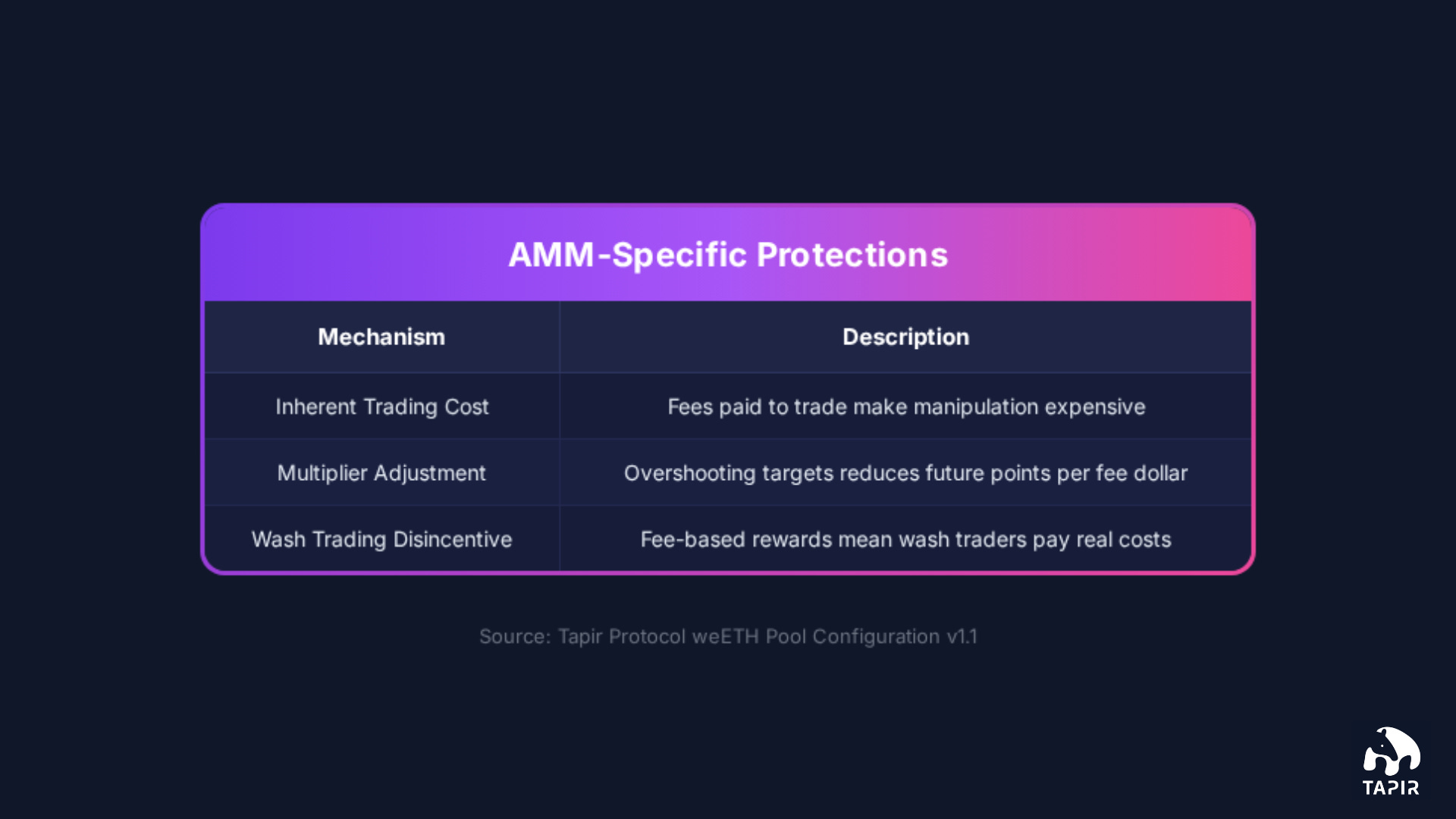
By setting fee-based rewards, Tapir discourages wide, unused ranges and makes wash trading uneconomic. Moreover, LPs can earn both streams, as AMM LP positions count toward TVL accounting as well.
How you earn: two streams, one principle
Tapir ensures users are rewarded for 1) held TVL and 2) fees earned. You earn 1) TVL points by holding DP and/or YB tokens in a given pool, and you earn 2) AMM points by providing liquidity to the pool’s AMM.
For TVL points, Tapir only counts a position if you hold it for a full UTC day. It takes snapshots of user balances at 00:00 UTC. Transfers reset the holding period for the transferred amount. Positions held for less than 24 hours earn zero for that day. Thus, daily TVL points are computed as (DP + YB balance) × asset price × a pool multiplier, but only if you hold through the full day.
Think of TVL points as:
(Your dollar exposure, per day) × (a pool-specific “points per dollar” rate).
Concretely, each day:
Tapir looks at your DP + YB balance at the daily snapshot.
It multiplies by the asset’s USD price to get a dollar value proxy.
It multiplies by a pool TVL multiplier (call it α) to turn dollars into points.
If you didn’t hold the full day, the result is forced to 0.
Then Tapir sums those daily values across the days in the epoch to get your raw TVL points for the week.
For AMM points, liquidity providers are rewarded based on fees they actually earn, not on liquidity size. This is a choice to avoid paying for liquidity that never trades.
Think of AMM points as:
(Your fees earned this week) × (a pool-specific “points per fee-dollar” rate).
Concretely, for the epoch:
Tapir totals the USD fees you earned as an LP in that pool (call this F).
It applies a pool AMM multiplier (call it β) to convert fees into points.
It multiplies by the underlying asset’s USD price at epoch end.
Together, the program optimizes for removing the incentive to post wide, unused liquidity ranges, tying rewards to protocol utility. It makes wash trading expensive because fees are real costs, and avoids last-minute time-weight gaming.
Caps and adaptive targets
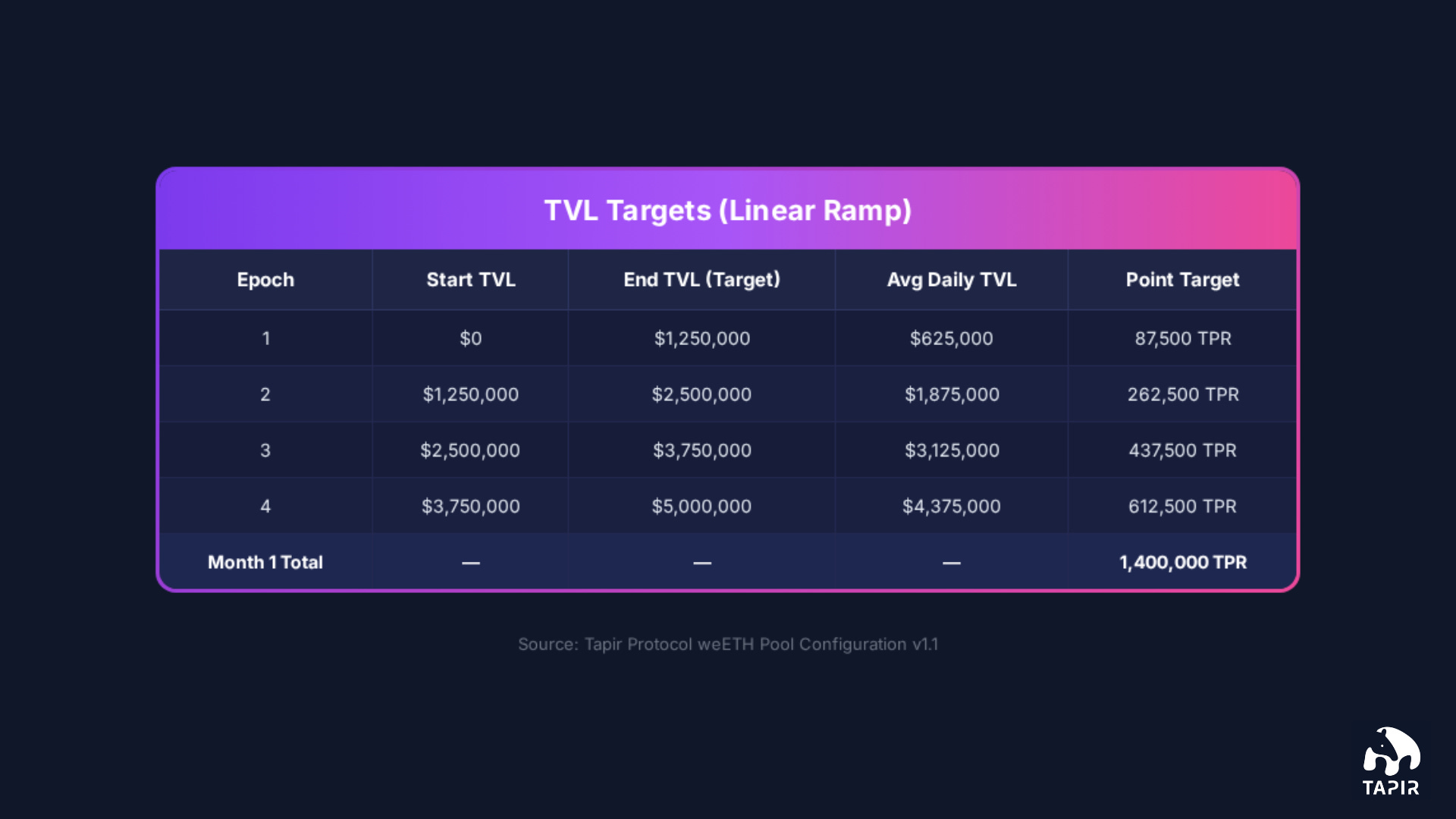
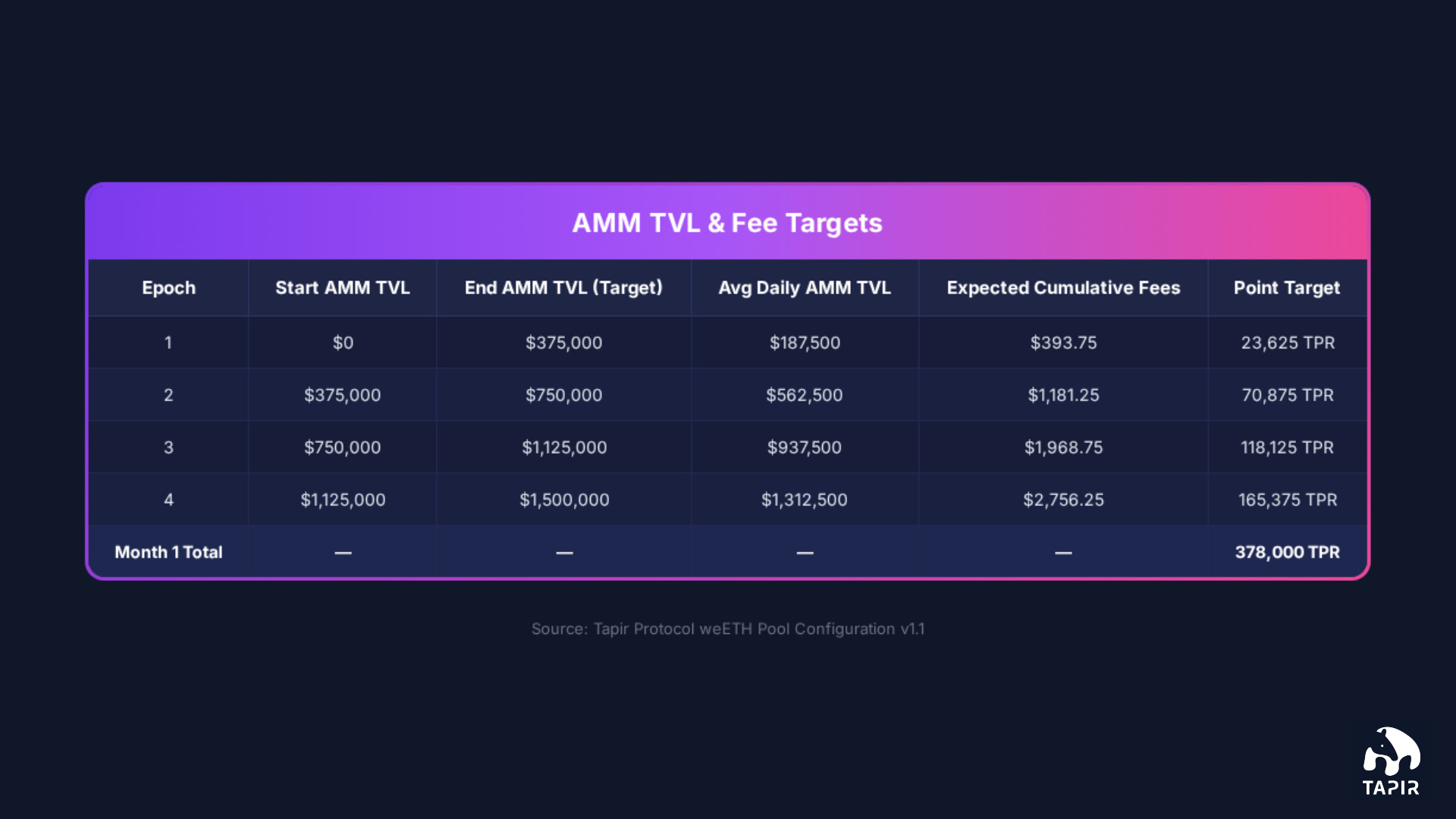
Each pool has two per-epoch targets set by governance: a TVL point target (max points paid for holding DP/YB), and an AMM point target (max points paid for LP fees). These targets define the pool’s points budget per epoch. If a pool overshoots its target, Tapir scales everyone down to the budget; if it undershoots, it simply pays full (unscaled) incentives to everyone.
Pool TVL target: 1,000,000 points
Raw points generated: 1,800,000
Scaling factor: 1,000,000 / 1,800,000 ≈ 0.556
Each participant’s final points get multiplied by ~0.556, and the pool distributes approximately 1,000,000.
Therefore, your points depend on your share of activity and how crowded the pool is relative to its target. If three holders had raw points of 800,000 / 600,000 / 400,000, then final points become roughly 444,444 / 333,333 / 222,222, totaling approximately 1,000,000.
Each pool has two multipliers that adjust every epoch:
α for TVL points; how many points you earn per $ of TVL held (per day).
If you assume a reference value per point, say $0.03/TPR for modeling, you can translate α into an implied APR: α × 7 × 52 × (TPR price). For instance, in Tapir’s weETH pool, where α is set to 0.02, it would be targeting ~20–22% reward APR in token value.
Thus, $1,000,000 held for 7 days earns 0.02 × 1,000,000 × 7 = 140,000, where token value ≈ 140,000 × $0.03 = $4,200 ($4,200 / $1,000,000 ≈ 0.42% weekly ≈ 21.8% APR).
β for AMM fee points; how many points you earn per $ of AMM fees earned.
Following the example of Tapir’s weETH pool, assuming 30% of TVL in the AMM and 10% daily turnover (volume/TVL) with a 0.3% fee tier, the expected weekly fees can be modeled as: avg AMM TVL × turnover × 7 × fee tier. In the weETH configuration, where β is set to 60, it’s also calibrated to produce ~20–22% reward APR on the AMM portion under those assumptions.
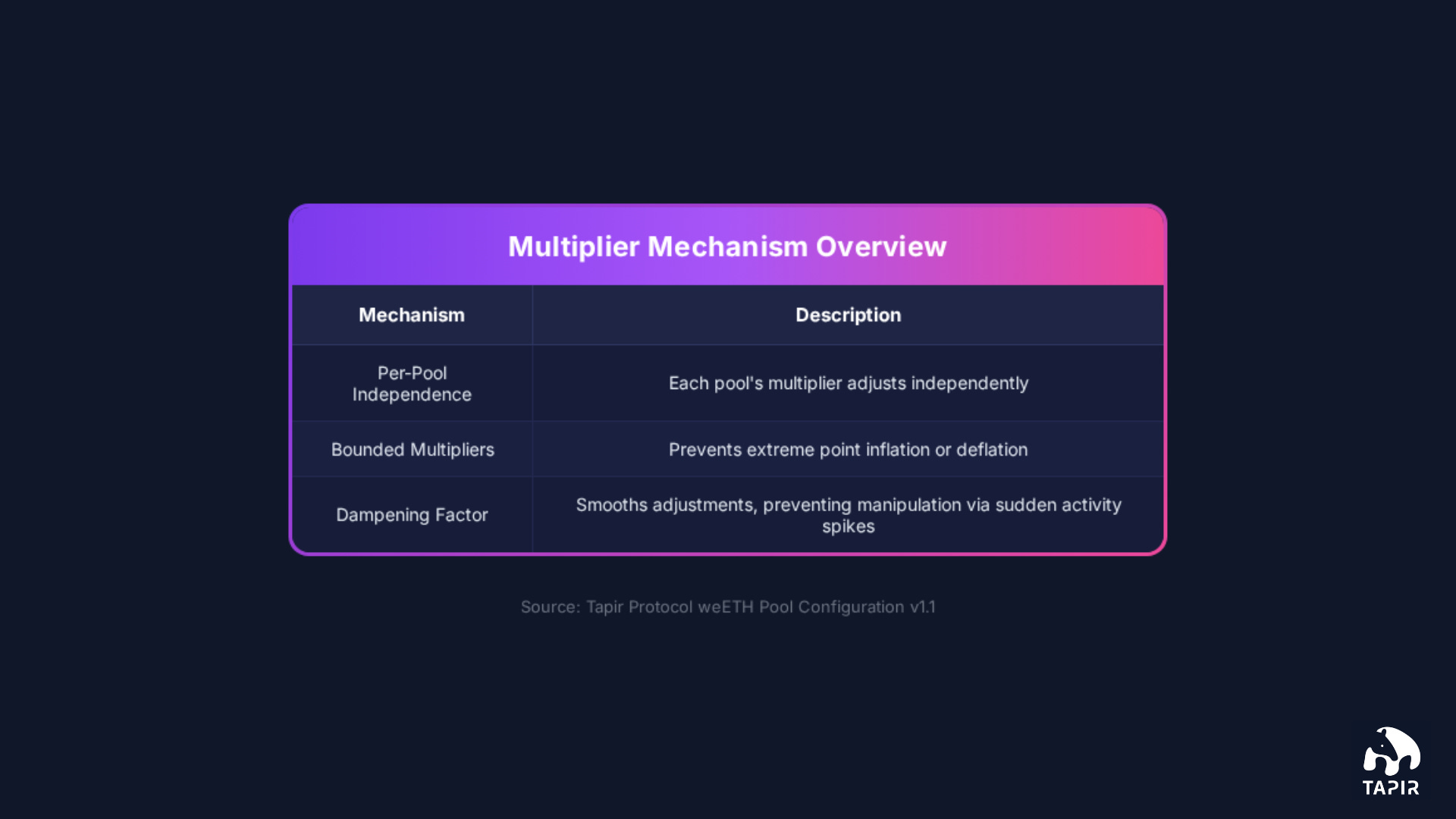
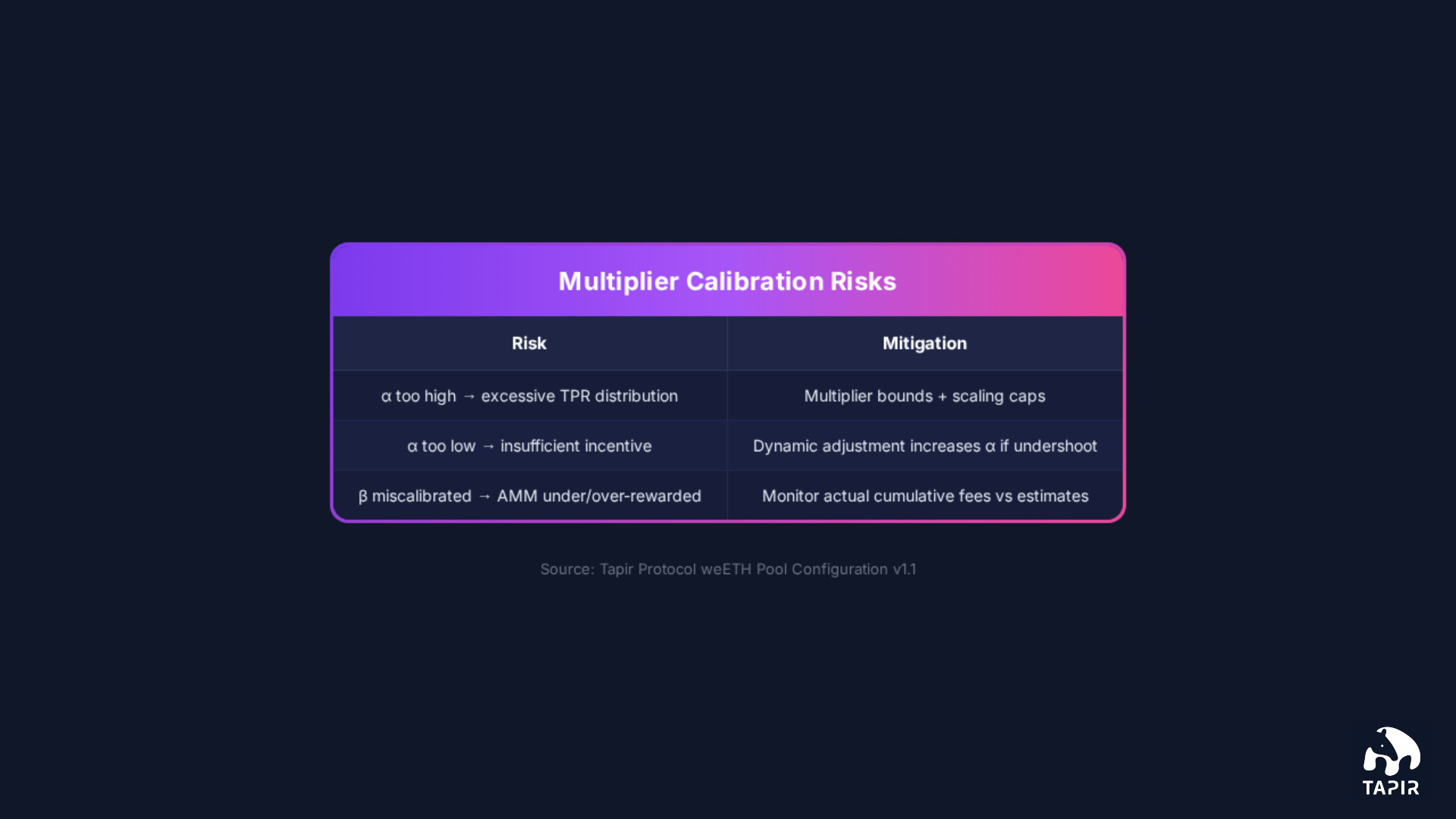
If a pool undershoots its target, the multiplier rises in the next epoch. If it overshoots, the multiplier falls. This allows Tapir to react to true demand, dampening adjustments with γ = 0.5 by default (i.e., the new multiplier moves only halfway toward the fully implied adjustment, smoothing epoch-to-epoch volatility). Governance can set γ anywhere in the 0.1–1.0 range, and multipliers are bounded to prevent extreme outcomes: α ranges 0.005–1.0; β ranges 1.0–1,000.0.
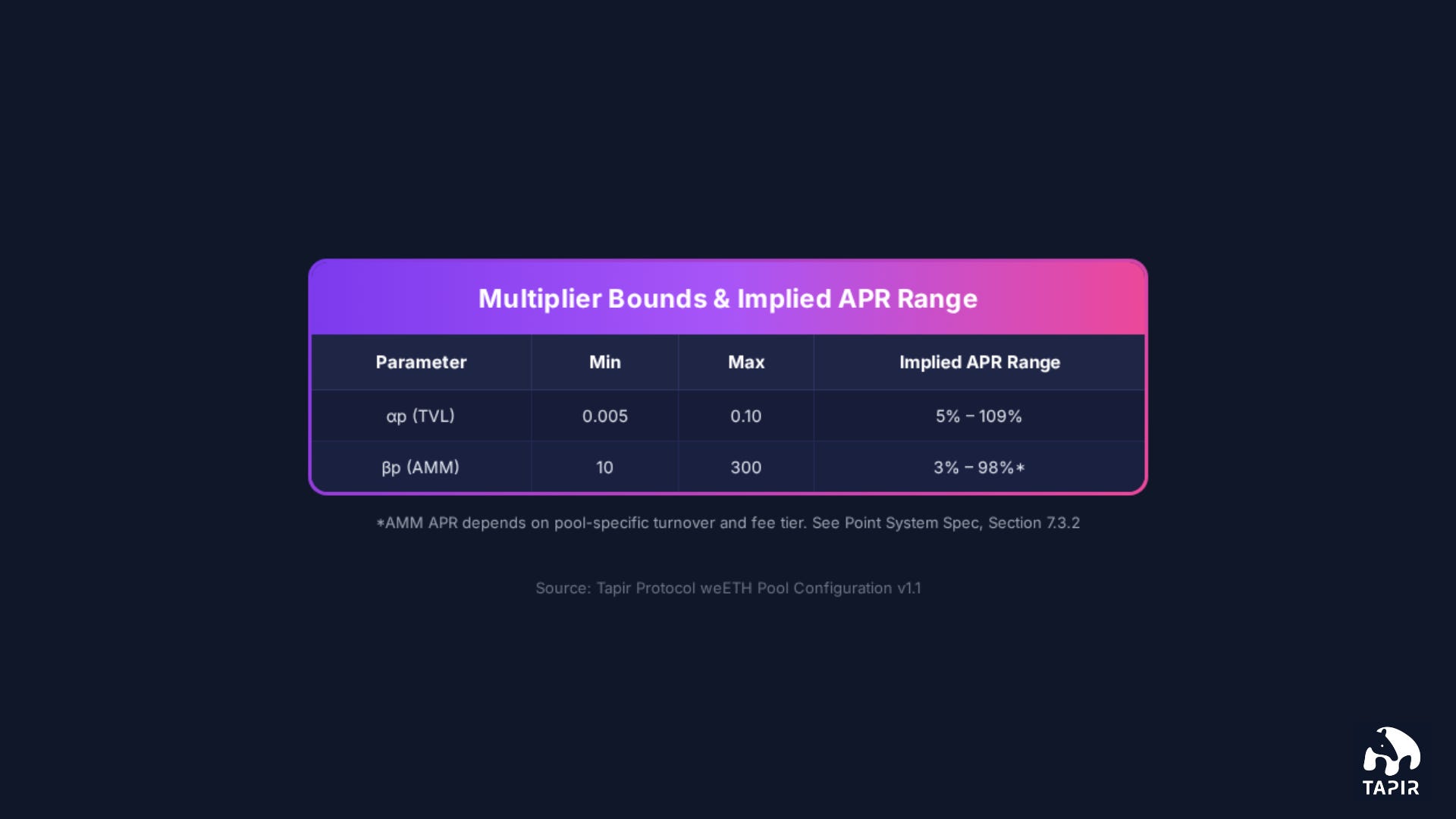
How Big Is The Reward Boost
Multipliers adjust each epoch based on over/undershoot.
Overshoot → incentives get sparser next epoch.
Undershoot → incentives get more plentiful.
The system tries to converge on “enough liquidity, without runaway emissions.” Thus, in Tapir, the “boost” can only come from two levers:
Higher initial multipliers (α and/or β)
TVL: raw points scale linearly with α.
AMM: raw points scale linearly with β (raw AMM points = β × fees).
Higher per-epoch pool targets (the cap)
Targets determine whether participants get haircutted by oversubscription scaling (κ). Higher targets reduce the chance of κ < 1.
If the pool is not oversubscribed (κ ≈ 1), increasing α by 50% increases TVL points by ~50%; increasing β by 50% increases AMM points per fee dollar by ~50%.
On the contrary, if the pool is oversubscribed (κ < 1), raising targets can matter as much as raising multipliers because it pushes κ back toward 1.
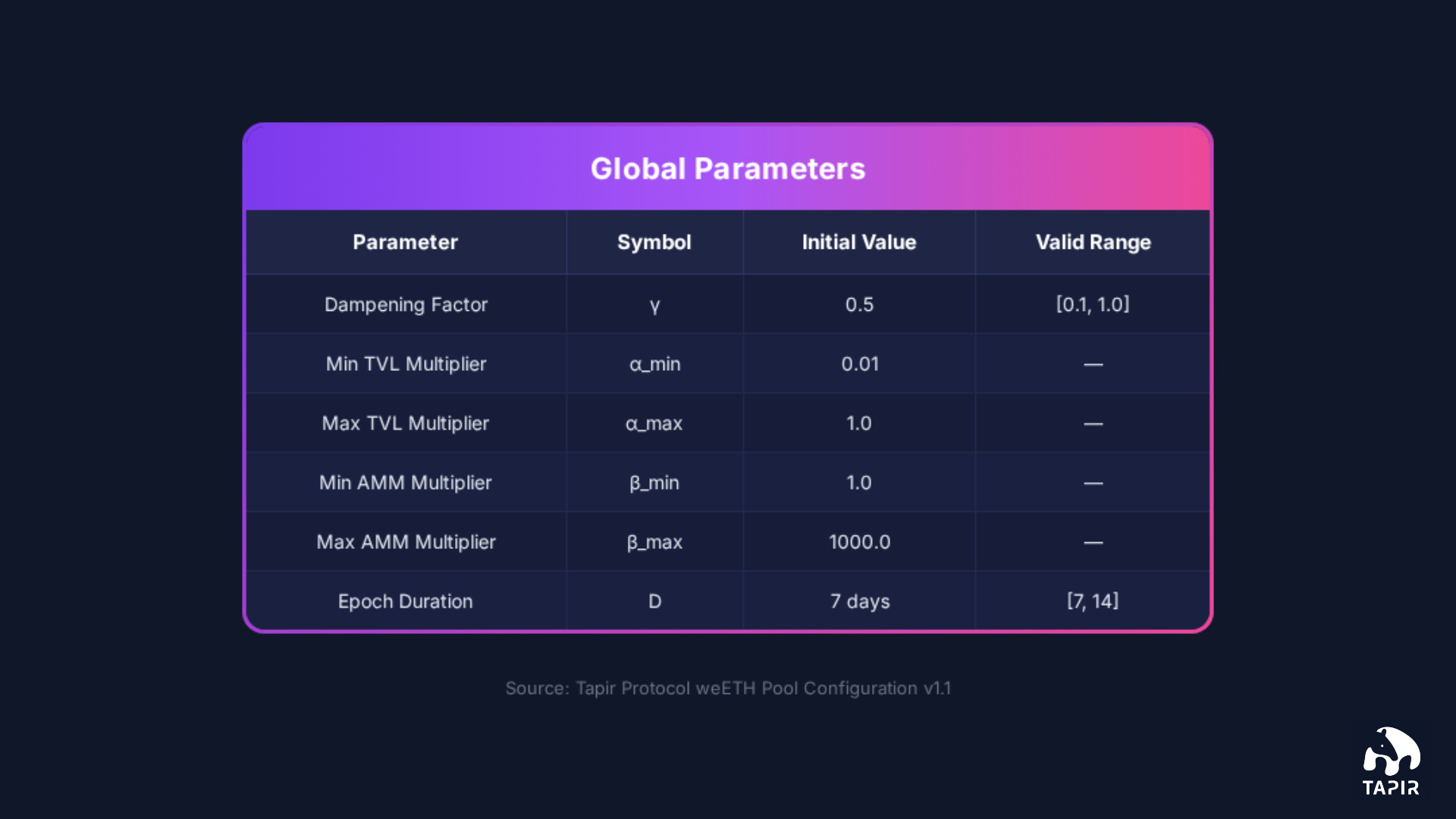
Private mainnet launches next week with boosted rewards for early adopters. The boost is implemented by setting higher initial pool parameters for the first epochs: TVL rewards use elevated initial α and AMM rewards use elevated initial β values, alongside higher per-epoch pool targets. Exact boost parameters will be published at mainnet launch.
Practically, this increases points per dollar-day (TVL) and points per dollar of earned fees (AMM), subject to the same pool-level emission caps and scaling if demand crowds in.
You can earn quickly; you cannot exit instantly
Tapir time-locks points before conversion to TPR. This allows it to spread out unlocks over time and reduce one-day supply shocks. It also forces participants to underwrite the protocol’s medium to long-term path, not just its launch.
Earliest earners face a 90‑day cliff from TGE.
Points earned before TGE unlock smoothly across TGE+90 to TGE+180 (linear schedule based on earn date).
Points earned on/after TGE follow a 180‑day lock from earn date.
Points remain non-transferable until you convert them to TPR.
As an allocator, you can choose your strategy based on your desired exposure: a) TVL (DP/YB holding) fits allocators who want lower operational overhead and can hold through daily cutoffs, b) AMM LPing (fee-based points) fits allocators who can manage ranges, inventory, and rebalancing, or c) for running both in parallel.
LPs earn both TVL points (for tokens in LP position) and AMM points (for cumulative fees earned):
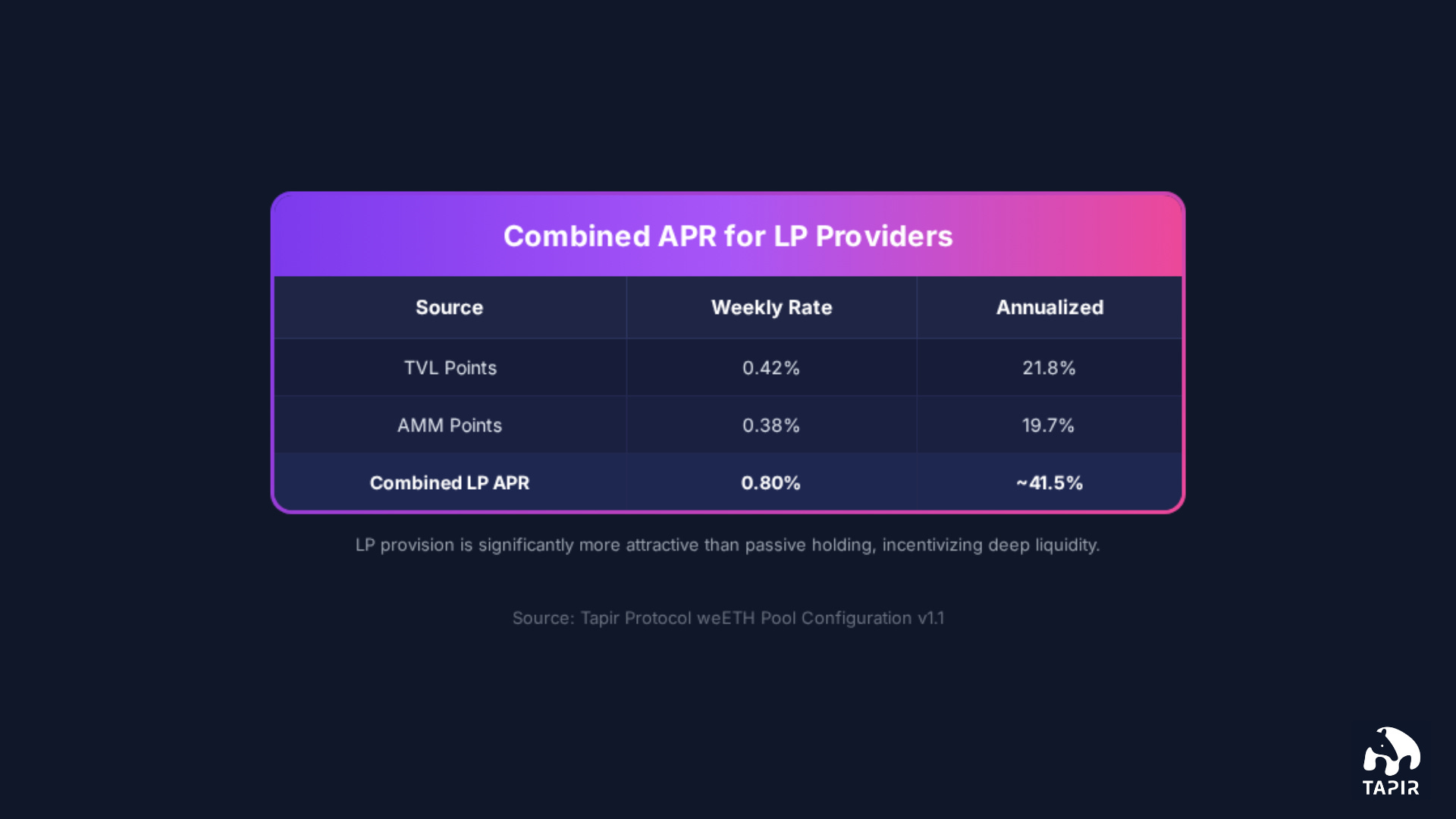
This makes LP provision siginificantly more attractive then passive holding, incentivizing deep liquidity
For each pool you deposit, track:
TVL and AMM targets (points budget).
Whether the pool is oversubscribed (scaling factor <1).
α and β multipliers and their direction of change (undershoot → up; overshoot → down).
Your own unlock timeline (pre‑TGE vs post‑TGE earn dates).
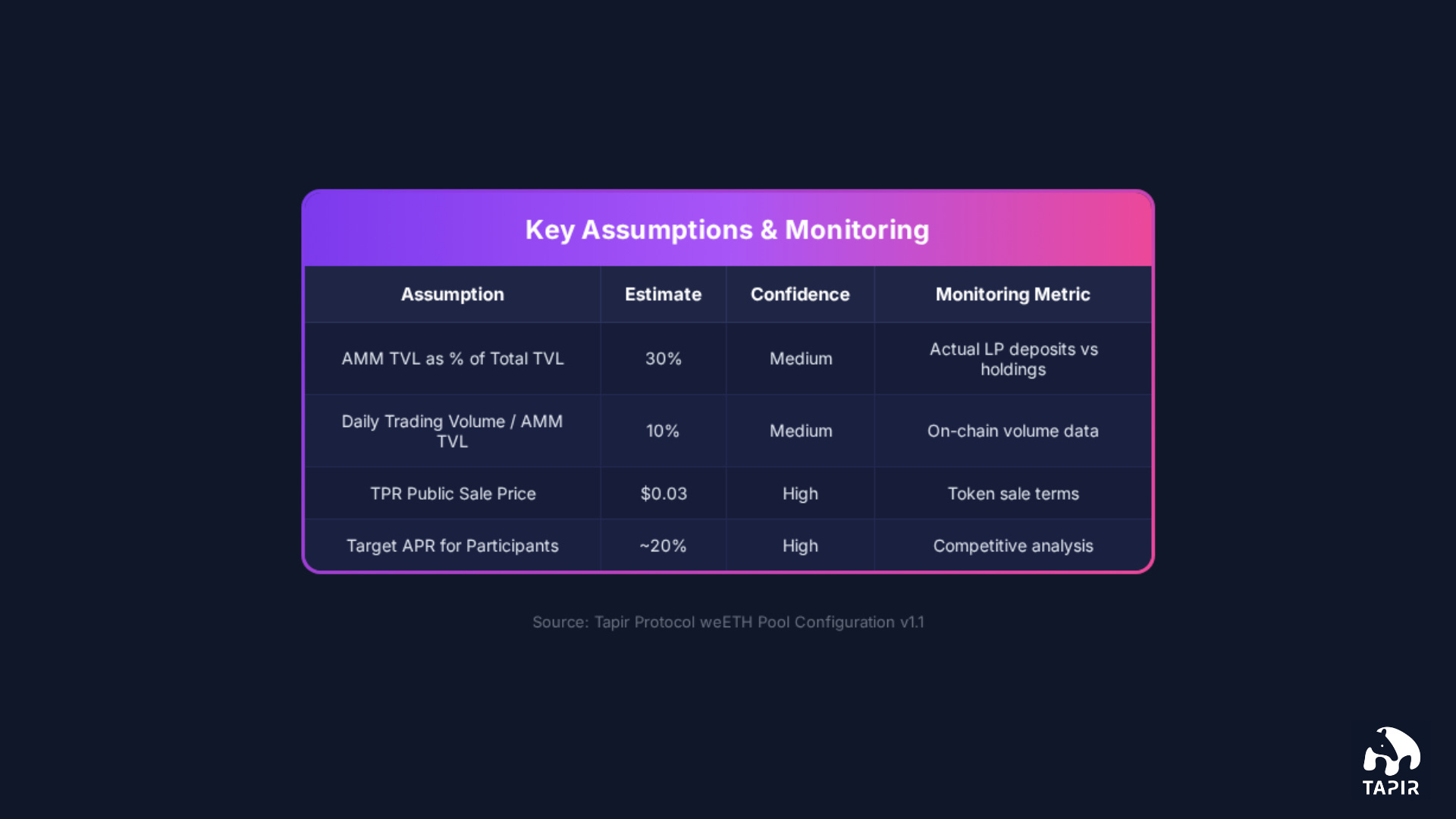
The Takeaway
Tapir treats points as a controlled distribution system, not a marketing meter. It uses:
Fee-based rewards to pay for liquidity that clears trades.
Time-based eligibility to block snapshot games.
Pool-level targets and scaling to cap emissions.
Adaptive multipliers to steer participation without blowing out dilution.
If you allocate, you do not need to guess the program’s intent. You can read the budget, watch oversubscription, and size positions based on the same inputs Tapir uses to calculate rewards.
Public testnet is live. Use it to get the opportunity to participate in the private mainnet, get familiar with weekly targets and crowding haircuts.
References
Tapir Protocol: Point System & Liquidity Incentive Specification