


Risk transfer mechanisms have underpinned financial markets for centuries. Yet the fundamental challenge remains unchanged: how does a protection buyer gain confidence that the seller will honor their obligation when a claim arises?
What is Depeg?
A depeg occurs when a token trades below the price it is designed to track—for example, a USD stablecoin dropping to $0.95.
Tapir is an on-chain structured product that splits a yield-bearing position into senior and junior claims, enabling participants to pay (or earn) an explicit depeg protection without relying on an underwriter’s balance sheet. The goal is to offer counterparty-minimized protection with transparent, pre-defined settlement.
In Traditional Finance, this confidence rests on regulation, capital requirements, supervision, and resolution frameworks. In DeFi (Decentralized Finance), many risk-transfer products operate without comparable ex-ante supervision or ex-post enforcement (stablecoin depegs, LST discounts, etc.). This creates a structural tension between capital efficiency and counterparty risk that existing models struggle to resolve.
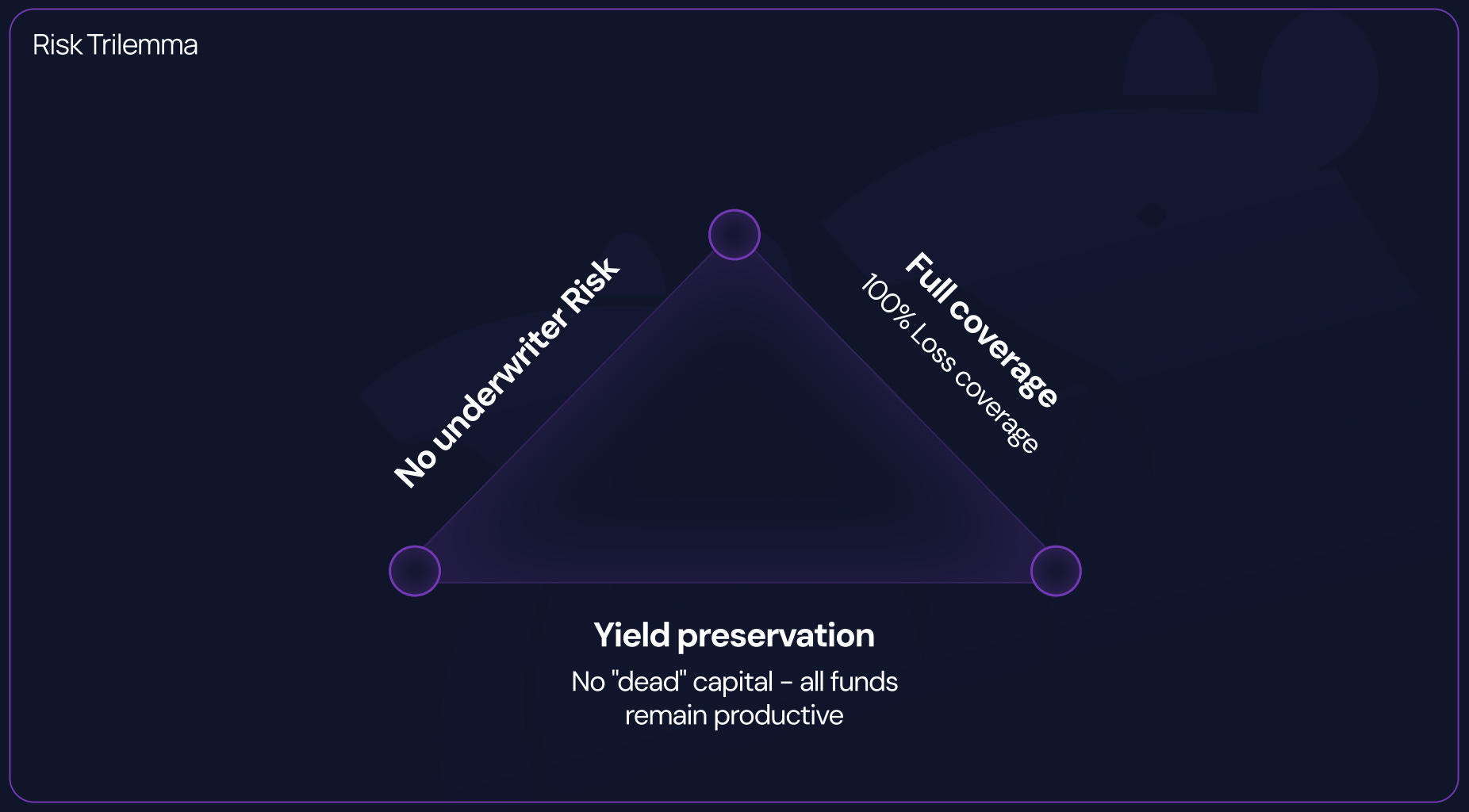
This article compares two main risk mitigation models and introduces the Risk Trilemma framework.
It examines how tranching mechanisms can achieve trust-minimized risk protection without sacrificing capital efficiency and why it is much better suitable for the DeFi environment.
Underwriting Models: A Taxonomy
Risk underwriting falls into two categories, each with distinct capital structures and counterparty risk profiles. We focus on (I) balance-sheet underwriting and (II) fully collateralized underwriting. Mutualized risk pools and discretionary-claims models introduce different design constraints (governance, adjudication, operational processes) and are not addressed here.
Balance Sheet Underwriting
Balance sheet underwriting is the dominant model in traditional risk underwriting. The underwriter assumes liability on its own balance sheet without designating specific assets against individual policies. Claims are satisfied from general capital reserves, with no recourse to ring-fenced collateral.
This model is effective when claims are diversified and weakly correlated. A single unit of capital can support multiple policies simultaneously as long as tail events are rare and uncorrelated across the book. When claims become correlated (market-wide stress, shared collateral types, systemic depegs), effective leverage decreases, and solvency becomes the binding constraint.
The principal limitation is counterparty risk. Policyholders have limited visibility into the underwriter’s risk management, asset-liability matching, or exposure concentrations. In correlated-claim scenarios—systemic events, market-wide depegs, or cascading liquidations—the underwriter’s capacity to honor obligations becomes uncertain. The policyholder’s claim is an unsecured liability against the underwriter’s general estate.
Fully-Collateralized Underwriting
Fully-collateralized underwriting inverts this structure. The underwriter posts designated collateral against each policy, granting the policyholder direct recourse to earmarked assets upon a qualifying event. This approach mirrors the funded structures commonly employed in insurance-linked securities and collateralized reinsurance markets.
This model eliminates counterparty risk, since the protection buyer holds a secured claim against identifiable collateral, verifiable on-chain in DeFi contexts. Settlement becomes deterministic rather than dependent on the underwriter’s solvency or willingness to pay.
The cost is capital intensity. Coverage capacity is constrained by posted collateral and associated liquidity terms (e.g., withdrawal and settlement mechanics). While collateral may be yield-bearing, the binding constraint is still funding: protection capacity must be financed up front, and that cost is ultimately reflected in premiums.
The Risk Trilemma
These two models represent opposite ends of a spectrum, each optimizing for different properties at the expense of others. In regulated markets, balance sheet underwriting predominates because regulatory infrastructure provides quite effective mitigation of counterparty risk. Solvency requirements, statutory reserves, and supervisory oversight create accountability mechanisms that substitute for direct collateralization.
Decentralized finance lacks an equivalent enforcement infrastructure. Smart contracts can enforce rules, but they cannot compel an undercapitalized counterparty to produce funds that do not exist. This environment surfaces a fundamental trilemma—three desirable properties that prove difficult to achieve simultaneously:
Capital Efficiency: The ability to provide coverage without requiring equivalent collateral lockup, preserving capital productivity
Counterparty Risk Elimination: No reliance on underwriter solvency, creditworthiness, or willingness to perform
Coverage assurance: Assurance that protection against the claim will be honored. Both underwriters will have the intent and the means to honor their claim
Balance-sheet underwriting is capital efficient but introduces credit exposure to the underwriter. Fully collateralized structures reduce credit exposure but impose higher capital intensity and liquidity constraints.
The question becomes whether an alternative structure can optimize across all three dimensions.
Tranching as a Resolution Mechanism
Structured finance has long employed tranching to redistribute risk across investor classes with heterogeneous risk appetites. The same principle applies to decentralized risk protection markets.
Tapir Protocol implements this approach by bifurcating yield-bearing tokens into two subordinated tranches:
DP (Depeg Protected): Senior tranche entitled to par redemption, protected against depeg events up to a defined threshold
YB (Yield Boosted): Junior tranche absorbing first-loss exposure in exchange for enhanced returns
Both tranches maintain claims on identical underlying collateral. Both continue to accrue the underlying yield throughout the protection period. The distinction lies solely in the loss waterfall: depeg losses are allocated first to YB holders until their tranche is exhausted, with DP holders bearing residual losses only thereafter.
The market price differential between DP and YB tokens reflects the implied cost of protection—effectively the premium that risk-averse participants pay to risk-tolerant participants for assuming subordinated exposure.
Mechanism Properties
This tranched structure delivers several properties that address the Risk Trilemma:
Counterparty Risk Elimination. Both DP and YB positions represent claims on actual underlying collateral held within the protocol. No party relies on an external underwriter’s balance sheet or solvency. Settlement is deterministic, governed entirely by smart contract logic and observable price feeds.
Full Collateralization of Senior Tranche. DP holders maintain a secured position backed by the combined underlying of both tranches. In a depeg scenario, their claim is satisfied from YB holders’ collateral allocation before any loss accrues to the senior tranche.
Risk-Adjusted Compensation for Junior Tranche. YB holders receive the underlying yield plus an implicit risk premium derived from the DP/YB price differential. This premium compensates for their first-loss exposure and elevated risk profile.
Capital Efficiency Through Continuous Yield Accrual. Unlike traditional collateralized protection models, where locked capital sits unproductive, both tranches remain fully deployed in the underlying yield-generating strategy. Neither protection buyers nor protection sellers sacrifice capital productivity. The protection mechanism operates as an overlay on existing yield positions rather than requiring dedicated reserve capital.
Algorithmic Claim Resolution. Settlement terms and depeg thresholds are codified at position inception, with claim execution governed entirely by smart contract logic and oracle price feeds. No manual adjudication, governance vote, or counterparty approval is required. This deterministic payout structure eliminates the operational and reputational risks inherent in discretionary claims processes.
Oracle Risk Mitigation. Deterministic settlement depends on price feed integrity. To mitigate oracle manipulation and single-point-of-failure risk, the protocol employs multiple independent oracle sources and applies price sampling across the five days preceding pool maturity. This time-weighted approach reduces exposure to transient price dislocations, flash-loan-driven manipulation, and individual oracle failures.
Structural Limitations
Because DP holders’ claims are secured against YB holders’ allocation, protection capacity is bounded by the junior tranche’s value. The protocol currently employs a symmetric 50/50 split between DP and YB tranches. Under this structure, the YB tranche can absorb depeg losses up to 50% of the high watermark price. Beyond this threshold, the junior tranche is fully depleted and residual losses pass through to DP holders.
The 50/50 ratio balances protection depth with junior tranche attractiveness. A larger junior tranche would extend coverage but dilute YB holders’ risk premium, reducing demand for the subordinated position. A smaller junior tranche would concentrate the premium but narrow the protection buffer. The symmetric split provides a natural equilibrium for the initial protocol version.
For most half-sane yield strategies, 50% buffer is more than enough. Higher losses represent extreme tail events typically associated with a fundamental protocol flaw—this coverage ceiling provides adequate protection for most risk management objectives.
Additionally, while smart contracts serve as the trust-minimisation layer that enables deterministic settlement, they introduce their own risk surface. However, Tapir meaningfully reduces aggregate smart contract exposure rather than adding to it. The smart contract trust assumption collapses into trust in a single codebase: Tapir’s own contracts(the core contract has 314 lines of code). Because the protocol protects against downstream depeg events, the security of the underlying yield platform becomes the hedged risk rather than an unhedged exposure.
This is especially relevant because the highest-yielding opportunities in DeFi are disproportionately available through newly launched protocols—platforms with limited track records and unproven codebases.
Without Tapir, an investor must perform rigorous due diligence on each new protocol, a burden that scales linearly with every opportunity pursued. With Tapir, due diligence on the smart contract dimension needs to be performed only once, rather than repeated for every new deployment.
Tapir’s safety is also independent of token economics, eliminating an entire class of economic exploit vectors common in yield-generating protocols. While smart contract risk cannot be fully eliminated, the protocol’s minimalism, auditability, and isolation from tokenomic complexity substantially reduce the attack surface relative to the multi-protocol exposure it replaces.
Comparative Analysis
The tranched model achieves a previously unavailable combination: counterparty risk elimination comparable to fully-collateralized structures, with improved capital efficiency relative to traditional collateralized models. Unlike balance-sheet underwriting—where capital efficiency derives from leveraging a single reserve across multiple uncorrelated policies—the tranching model preserves capital productivity through continuous yield accrual on all posted collateral. Neither protection buyers nor sellers sacrifice yield exposure to obtain or provide coverage. The cost is a bounded protection range rather than unlimited coverage.
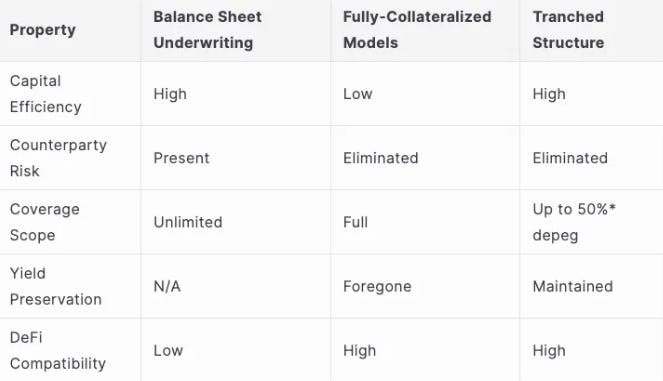
* While we believe the 50% coverage is sufficient for most assets, subsequent protocol iterations are intended to extend protection capacity beyond the current junior-buffer ceiling—ultimately targeting full 100% depeg protection—subject to additional design and risk constraints.
Conclusion
The Risk Trilemma framework illuminates why traditional risk models translate poorly to decentralized environments. Balance sheet underwriting requires a trust infrastructure that does not exist on-chain. Full collateralization imposes opportunity costs that render protection economically unviable for many participants.
Tranching offers a third path. By restructuring claims on existing yield-bearing collateral rather than requiring dedicated capital reserves, protocols can deliver trustless risk transfer without sacrificing capital productivity. Both protection buyers and sellers maintain yield exposure while achieving their respective risk management objectives.
This represents a native DeFi primitive—not an adaptation of traditional models, but a mechanism designed specifically for the constraints and capabilities of programmable, permissionless financial infrastructure.
Thanks for reading! Subscribe, Share & Comment.
- Additional documentation available at docs.tapir.money
- for news follow tapir on X
