
By the Tapir team
Zircuit Finance is an onchain yield platform that pays institutional-grade yield on USDC and USDT, built so a depositor can actually understand where that yield comes from. The structure behind it is unusually disciplined for DeFi (decentralized finance). Capital is deployed to regulated asset managers including Wisdomtree, Monarq Asset Management, Forteus, FalconX, B2C2, and Fidelity; the protocol holds senior-creditor protections over its loans, and the smart contracts are independently audited. Zircuit Finance was incubated by a team from Quantstamp, which has secured more than $500 billion in assets across 1,300+ audits.
That is a security stack built layer by layer. This article is about a new layer being added to it, one that no protocol can build from the inside, and what it lets a Zircuit Finance holder do that they could not do before.
First, what a depeg actually is
A depeg happens when a token trades below the price it is designed to track. A US-dollar stablecoin that slips to $0.95 has depegged by 5%. A liquid staking token (LST) that loses its peg to the underlying asset after a slashing event has depegged. The dollar figure can look small per token, but the event is the single most common loss event in DeFi.
The numbers say the rest. Moody’s counted 1,914 depeg events across the top 25 stablecoins in the first nine months of 2023 alone, 609 of them in large-cap names, counting any move greater than 3% inside 24 hours. Between November 2020 and November 2025, depeg events cost holders an estimated $1.1–3.3 billion, from our own per-event research across 60+ events, and that range excludes the Terra and IRON collapses, which were category failures rather than peg deviations. And yet, of the $150 billion-plus in yield-bearing DeFi assets (DefiLlama, Q4 2025), under 0.2% carries any form of protection against this. That last figure is our own derivation, and it is simple arithmetic: the entire on-chain protection sector holds roughly $110–150 million of capital against $80–150 billion of exposure. The most common way to lose money in DeFi is also the least hedged.
The reason is structural, not accidental. We will come back to it.
The layer that no yield structure can build on its own
Zircuit Finance issues omnichain receipt tokens, zvUSDC and zvUSDT, that accrue yield through a rising price-per-share rather than by changing in quantity. The underlying capital sits across regulated venues with senior-creditor terms and on-chain liquidity buffers. The design is built precisely to keep that receipt token tracking par, and every layer of the stack is there to make that hold.
What no protocol can add from the inside, however well engineered, is a counterparty. A market needs someone external who wants the opposite position. If a holder would rather give up a slice of yield in exchange for protection, somebody else has to want that slice enough to take the risk on. That person cannot come from within the vault. This is the layer that has been missing across the whole category, which is why so much of that capital sits unhedged, and it is exactly what Tapir adds.
What Tapir is (and what it is not)
Tapir is a depeg protection marketplace for yield-bearing tokens. It takes a single yield-bearing position and splits it into two tradable claims:
DP (Depeg Protected): the senior claim. It provides protection at settlement against qualifying depegs up to the structural 50% limit. Beyond that, DP also takes losses.
YB (Yield Boosted): the junior claim. It absorbs first-loss exposure to a depeg, and in exchange it earns a boosted yield.
The feature that makes this work where nothing else has: every side keeps 100% of the base yield. The underlying keeps earning base yield, but the DP buyer pays a market-priced protection premium. Fees also affect net returns. The YB holder takes on the risk and also keeps the full underlying yield, plus the premium. A liquidity provider standing between them keeps it as well, plus the trading fees. No capital sits idle waiting for a claim. Every dollar in the system stays productive.
For readers coming from traditional finance, the closest analogue is a credit default swap (CDS): an instrument that lets one party transfer the risk of a credit event to another for a price. CDS notional outstanding stood at approximately $11.0 trillion at end-December 2025 (Bank for International Settlements, Table D10.1). Tapir is the on-chain equivalent for the depeg risk in DeFi yield assets, with one difference that matters below.
A word on what Tapir is not. It is not insurance, and it has no policy and no policyholder. Tapir allocates depeg exposure between claims backed by the same yield-bearing position, without requiring a separate idle claims reserve. That capital efficiency is the benefit for Zircuit Finance holders who want to buy protection or earn a premium for accepting first-loss exposure.
The honest part
We care about saying this plainly. This is a risk product, not insurance and not risk-free. It carries smart-contract risk, market risk, liquidity risk, APY (annual percentage yield) risk, and depeg risk, and YB holders can lose principal in a depeg event. That is the whole point of the junior claim: YB holders absorb the first loss under the settlement formula, while DP holders retain risk beyond the protection limit and both sides retain protocol and underlying-asset risks.
Costs are short to list. The pool charges a 0.22% redemption fee when the market ends, and swaps carry a fee that shrinks as expiry approaches. There is no deposit fee, and the price of protection is paid to the other side of the trade rather than taken out of your yield.
Tapir’s contracts have been independently audited by Quantstamp and Hashlock. Audits reduce risk; they do not eliminate it. None of this is financial advice. What this layer offers is not the disappearance of risk. It is the ability to see that risk clearly, price it openly, and choose your side of it.
Why this fits the Zircuit Finance position specifically
Zircuit Finance already does the hard part on the supply side: it sources real, durable yield from regulated managers and protects its position as a creditor. What no vault can do alone is give a zvUSDC holder a clean, market-priced way to decide how much depeg risk they want to carry.
With Tapir sitting next to the Zircuit Finance USDC position, the same deposit becomes a choice rather than a single fixed exposure:
A treasury or a conservative allocator can hold DP and retain exposure to the Zircuit base yield while paying a protection premium. Protection applies at settlement to qualifying depegs up to the structural 50% limit; larger losses affect DP too.
A yield-seeker who is comfortable underwriting that exposure can hold YB, earn the Zircuit base yield, and collect a premium on top for standing behind the protected side.
A liquidity provider can back the market itself, supplying DP/YB liquidity and earning the trading fees on top of the base yield.
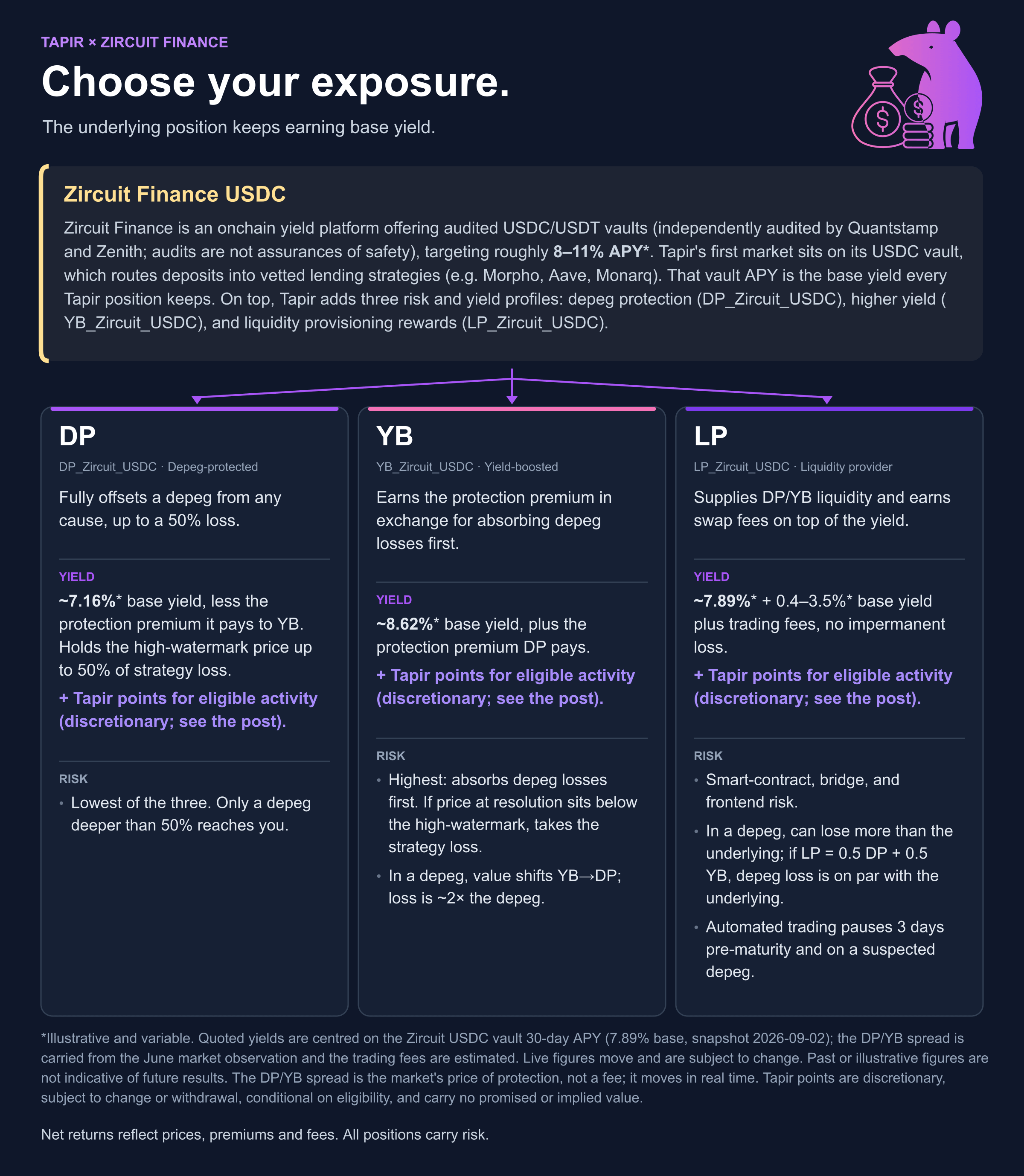
Tapir does not replace the vault. It expands what a Zircuit Finance position can do. The yield and the discipline behind it stay exactly where they are; the new part is a market on top, where each holder shapes their own exposure.
There is a second thing this layer produces. Once DP and YB trade against each other, the spread between them is a live, on-chain price of how the market rates that risk, readable by anyone from day one. A tight spread means protection is relatively inexpensive at that moment; it does not by itself establish that the underlying risk is small.
How the price of protection gets set
Here is where Tapir departs from both traditional collateralized protection models and a static fee schedule. The cost of protection is not set by an underwriter’s committee or a fixed rate card. DP and YB trade against each other on an automated market maker (AMM), so the market sets the price of protection in real time, continuously.
The DP/YB spread shows the market price of transferring depeg exposure. It reflects risk expectations, liquidity, incentives, and time to maturity; it is not a direct measure of depeg probability. Supply and demand determine the relative price of the two claims.
A simplified, illustrative example shows the shape of it. Zircuit Finance publishes a target range of 8–11% APY on its vaults, variable and not guaranteed. Take a round 9% from inside that range, purely to show the mechanic. A holder who wants protection buys DP: they keep the full base yield but give up a slice of it, set by the market, as the price of protection, netting something like 7.5% with depeg protection at settlement up to the structural 50% limit. A holder who wants more yield buys YB: they earn the same base plus that premium, netting something like 10.5%, in exchange for absorbing the first loss if a depeg occurs. In this simplified example, the base yield sits between the two returns: DP pays a premium and YB receives it. Actual returns depend on prices and fees. The roughly 3-point gap between the two is not a fee Tapir charges. It is the market’s price for moving the depeg risk from one holder to another. These are illustrative figures rather than a quote: the numbers move with the market, and it is the mechanic that stays.
Settlement without a claims process
The other place Tapir breaks from traditional protection models is the moment of truth. There is no claim to file, no adjuster, no governance vote on whether a depeg “counts.”
Resolution is parametric and rules-based. After a market expires and a short cooldown passes, with checks on the age of the oracle price, the outcome is computed on-chain directly from oracle prices, comparing a high-watermark to the resolution price. Anyone can trigger it. The payout follows from the rule, not from anyone’s discretion.
This design also makes the market solvent by construction. At resolution, the DP and YB redemption factors always sum to the same fixed total, so a depeg only redistributes value between the two sides. It never creates a shortfall the system has to cover from a reserve it might not have. There is no separate claims reserve to exhaust, although contract and oracle risks remain. For a protection product, that structural property is worth more than any marketing promise.
Where it stands
The first Tapir depeg protection market is live in limited access, on the Zircuit Finance USDC position. Access is deliberately staged while the market builds depth, because a protection market is only as good as the liquidity standing behind it. The public limited-access launch is September 22, 2026. Tapir points are planned to start on September 25 at 00:00 UTC, subject to activation readiness. Eligible DP, YB, and liquidity-provider activity earns points under the published program rules.
For a category that has gone largely unhedged since 2021, the more interesting milestone is not the launch itself. It is that, for the first time, a holder of an institutional-grade yield position can keep earning the underlying yield, with net returns reflecting premiums and fees, and still decide, in an open market, exactly how much of the depeg risk they want to carry. That is what the new layer adds.